
Tambaqui
The Amazon’s Giant Fruiteater
Tambaqui
The Amazon’s Giant Fruiteater
Guide
The Tambaqui is one of the Amazon’s most iconic and ecologically important fish. A massive, deep-bodied relative of the piranha and pacu, the tambaqui plays a vital role in dispersing seeds and shaping forest ecosystems. Reaching sizes over 80 pounds, this fruit- and nut-eating giant lives in flooded forests and lakes across the Amazon and Orinoco basins.
Although peaceful in appearance, tambaqui are powerful fighters on rod and reel. Their thick bodies and brute strength allow them to make deep, determined runs, and their unpredictable feeding behavior challenges anglers to adapt with unique baits and techniques. During low-water months, tambaqui may congregate in deeper pools and lagoons, becoming more accessible to sport fishers.
Interesting Facts & Notes
Tambaqui are the largest characins in the world—distant cousins of piranhas and tetras.
Their jaws can easily crack hard fruits and nuts like rubber tree seeds and palm nuts.
Tambaqui have specialized gill structures that allow them to survive in low-oxygen water.
Due to overfishing near urban areas, wild tambaqui are now harder to find near cities.
Extensively raised in aquaculture, tambaqui are also popular as a sustainable food source.
Where to Catch
Wild tambaqui are targeted in remote, protected waters. You can occasionally find them with Acute Angling at:
Peacock Bass Fishing Trips - Encounter multiple species while casting for peacocks
Quick Facts
| Attribute | Description |
|---|---|
| Scientific Name | Colossoma macropomum |
| Common Names | Tambaqui, Black Pacu, Cachama Negra, Giant Pacu |
| Size Range | Commonly 10–40 lbs; up to 80+ lbs in remote waters |
| Region | Amazon and Orinoco River basins |
| Habitat | Flooded forests, oxbow lakes, backwaters |
| Behavior | Frugivore; seasonal migrations during flood cycles |
| Coloration | Dark back, black fins, reddish to orange lower body |
| Aggression | Moderate – cautious, but strong and hard-fighting |
| Feeding Habits | Primarily fruits, nuts, and seeds; also crustaceans and insects |
| Gamefish Status | Respected for size and strength |
Physical Appearance
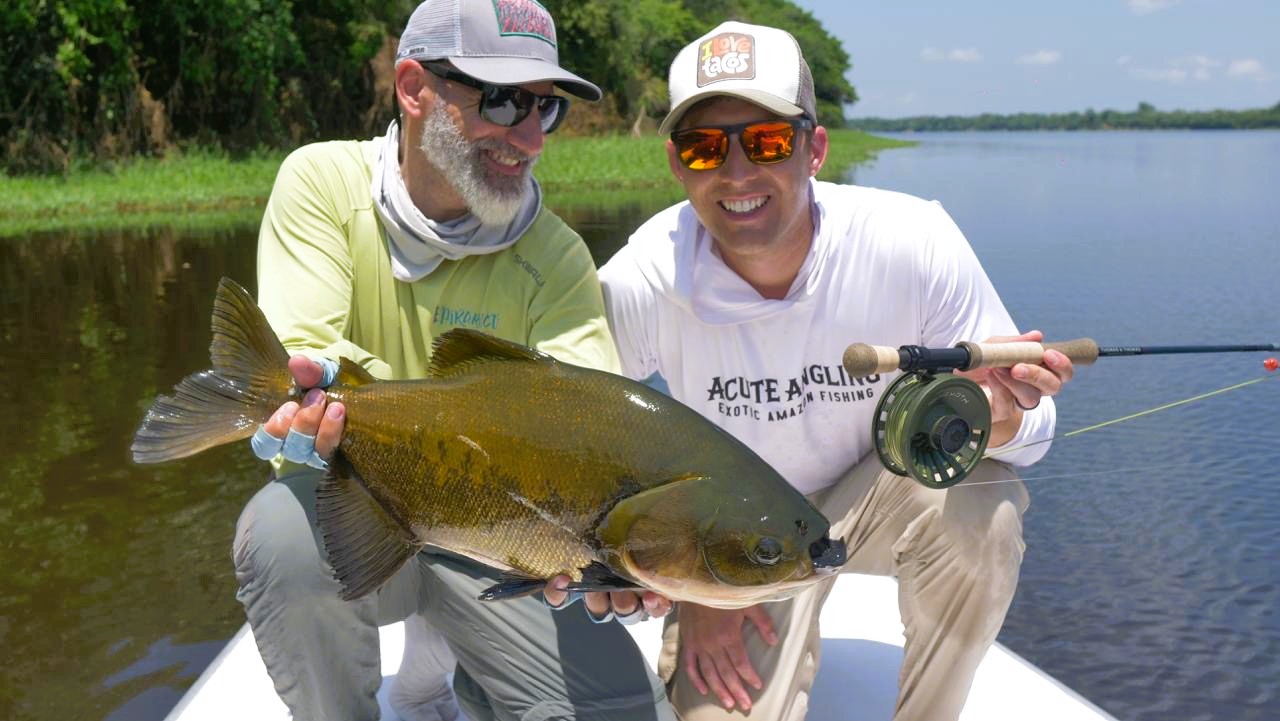
The tambaqui is a thick, oval-bodied fish with a blunt face, powerful jaws, and large eyes set close to the front of the head. Its dorsal and adipose fins are dark, while the body fades from gray-black on top to rich orange or reddish tones on the lower half. Large specimens can weigh over 80 pounds and have prominent, paddle-like tails. Juveniles may resemble pacu in shape and color but are typically darker and more robust.
How to Identify a Tambaqui
Broad, deep-bodied shape with a high back and thick girth.
Dark upper body with a reddish or orange underside and belly.
Rounded pectoral fins and broad caudal peduncle (tail base).
Blunt snout and small mouth with strong jaw structure.
Adipose fin is large and well-developed (unlike in smaller characins).
How to Catch Tambaqui
These frugivorous giants require thoughtful presentations. Matching their natural diet is often key to success, especially in still or low-oxygen waters.
Recommended Techniques
Use natural baits like fruit pieces, seeds, or dough balls near forested backwaters.
Fish slow and patient in oxbow lakes, lagoons, or flooded shorelines.
During low water, look for deeper holding areas with overhanging vegetation.
Suggested Gear
Rod: Medium-heavy spinning or baitcasting
Line: 30–50 lb braid or mono
Hooks: Strong 2/0–4/0 circle or J hooks
Extras: Dough bait, fruit scent attractants, or mesh bait bags
Related Reading
Join The Adventure
Ready to hook into a true Amazon heavyweight? Travel with Acute Angling to fish remote waters where wild tambaqui still thrive—and experience the incredible biodiversity of South America’s greatest rivers.
Contact us today:
📞 (866) 832-2987
References
Zeinad, A. K. & Prado, R. A. (2012). Peixes fluviais do Brasil: espécies esportivas
Goulding, M. (1980). The Fishes and the Forest
Nature: Arapaima gigas occurrence data
FishBase (2024). Colossoma macropomum profile. www.fishbase.org
Peacock Bass (Google Books, 2024): https://www.google.com/books/edition/Peacock_Bass/fMofEAAAQBAJ


