
Peacock Bass
The Apex Predator of the Amazon Rainforest
Peacock Bass
The Apex Predator of the Amazon Rainforest
Guide
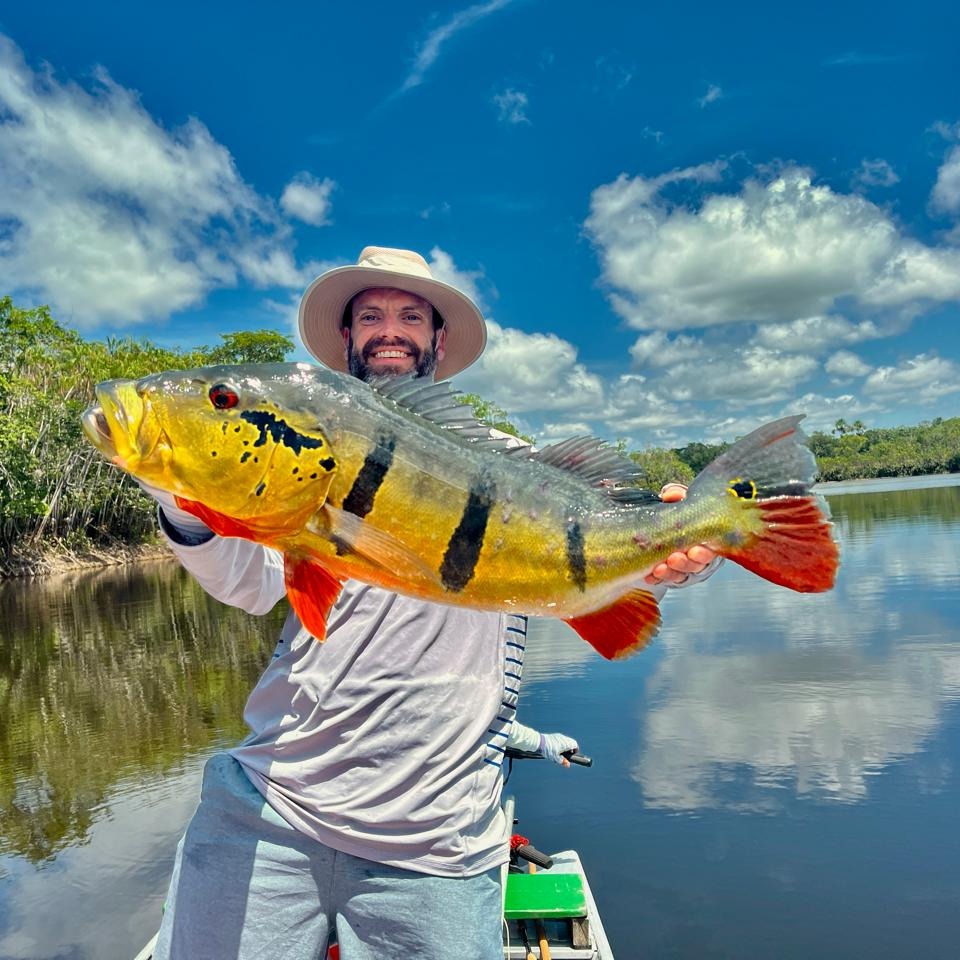
The peacock bass is the undisputed king of Amazon sportfishing—a fierce, powerful predator that smashes lures with explosive aggression and then tears through the water with brute strength. These strikingly colored cichlids are more than just beautiful; they’re one of the most exciting gamefish on the planet. Found throughout the Amazon Basin and other major South American river systems, the genus Cichla includes over a dozen described species, six of which are commonly caught on Acute Angling trips. Chief among them is Cichla temensis, the largest of all, capable of reaching up to 30 pounds and known for its world-class trophy potential.
Anglers travel from around the globe to fish for peacock bass in South America, especially in Brazil, where vast tributaries of the Amazon River offer the perfect conditions for catching both numbers and size. These trips deliver a uniquely thrilling fishing experience—not only because of the fish themselves, but because of the immersive, remote environments in which they live. Whether you’re casting prop baits into Rio Negro lagoons or pulling fish after fish from a hidden blackwater creek, peacock bass fishing in the Amazon is unlike any other adventure on Earth.
Interesting Facts & Notes
Cichla temensis holds the all-tackle world record at 29 pounds, caught in the Rio Negro.
Peacock bass aren’t true bass—they’re cichlids, more closely related to African tilapia than to largemouth.
Unlike most freshwater predators, peacocks are primarily visual hunters and rarely feed at night.
During the spawning season, males develop a prominent “nuchal hump,” especially in C. temensis and C. monoculus.
Where to Catch Peacock Bass
You can target various species of peacock bass on the following Acute Angling trips:
The Curicuriari: Trophy C. temensis
Blackwater Explorer: Premier trip for C. temensis
Floating Bungalows: Rio Negro tributaries for C. temensis
Rio Aripuanã: Great species variety and C. pinima
Xingu River: Rare species like C. melaniae
Quick Facts
| Feature | Description |
|---|---|
| Scientific Names | Cichla temensis, C. orinocensis, C. monoculus, C. melaniae, C. pinima |
| Common Names | Peacock bass, tucunaré, speckled peacock, butterfly peacock, ocellated peacock |
| Size Range | 3–15 lbs typical; up to 29 lbs (C. temensis) |
| Region | Amazon Basin, Orinoco Basin, Guianas, parts of northeast Brazil |
| Habitat | Lagoons, floodplain lakes, backwater creeks, shallow shorelines |
| Behavior | Ambush predator; highly territorial during nesting |
| Coloration | Varies by species: yellow, orange, green, black and more |
| Aggression | Extremely high, especially during pre-spawn/post-spawn phases |
| Feeding Habits | Piscivorous—feed almost exclusively on smaller fish |
| Gamefish Status | Top-tier Amazon gamefish, known for explosive strikes |
Physical Appearance
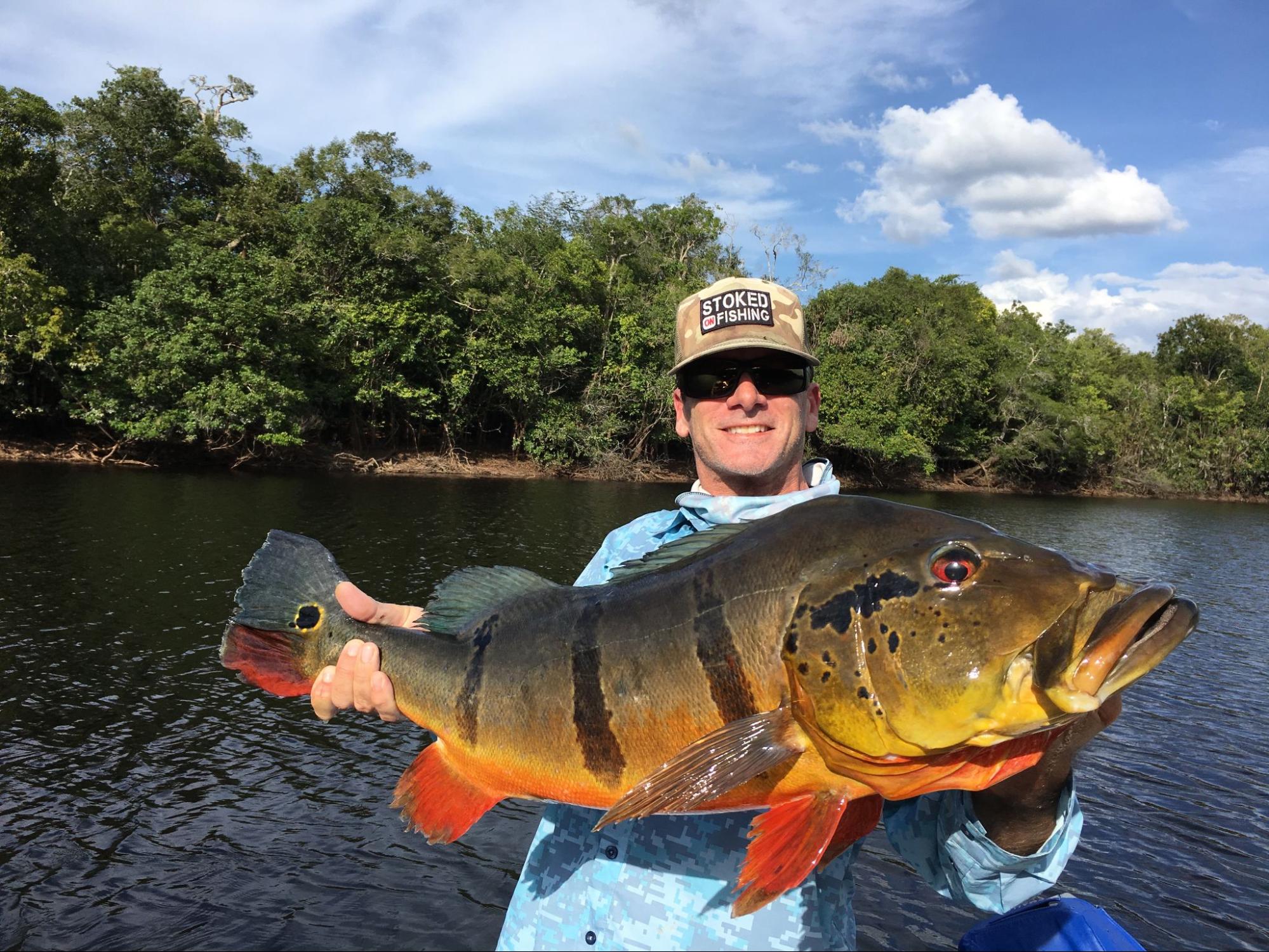
Peacock bass are deep-bodied, muscular cichlids with thick shoulders and wide tails that make them ferocious fighters. Color patterns vary greatly among species and even within the same species depending on maturity, reproductive status, and water clarity. Most peacocks exhibit vivid yellow to greenish sides, bold vertical bars or blotches, and the distinctive "eye spot" or ocellus on their tail—an evolutionary adaptation thought to confuse predators or rivals.
How to Identify Each Species
| Species | Distinctive Features | Notes |
|---|---|---|
| C. temensis | 3 broad vertical bars (açu phase), or speckled (paca phase); largest species; no tail eyespot in adults | Found mainly in Rio Negro, Orinoco, and blackwater tributaries |
| C. orinocensis | 3 vertical bars, plus eyespot on tail and sometimes on body; more elongated shape | Common in Rio Negro, Orinoco, and Branco |
| C. monoculus | 3 faint bars, dark lateral blotch, eyespot on tail, body more compressed | Found in the Madeira basin |
| C. melaniae | 3 wide vertical bars, elongated pectoral fin base, dark opercular spot | Common in Xingu |
| C. pinima | 3 clean vertical bars, yellowish flanks, tail eyespot | Common in Aripuanã |
Cross-Species Comparison Chart
| Feature | C. temensis | C. orinocensis | C. monoculus | C. melaniae | C. pinima |
|---|---|---|---|---|---|
| Max Size | 29+ lbs | 12–15 lbs | Less than 5 pounds | 10–12 lbs | 10–12 lbs |
| Tail Eyespot | Yes | Yes | Yes | Yes | Yes |
| Body Bars | 3 bold / speckled | 3 medium | 3 faint | 3 bold | 3 distinct |
| Coloration | Yellow/orange + black | Olive to gold | Yellow/green | Bronze/yellow | Golden-yellow |
| Region | Rio Negro | Negro/Orinoco | Madeira | Xingu | Aripuanã |
Fishing Tactics: How to Catch Peacock Bass
Fishing for peacock bass is all about aggression, accuracy, and variety. These fish strike with power and speed, often exploding on a lure multiple times in a row. While topwater lures provide the most exciting action, savvy anglers also carry a mix of subsurface baits for when fish are less active. The key to success lies in reading the water, varying your retrieve, and trusting your guide—they know where the giants lurk.
Most fishing is sight- or target-casting near structures such as submerged trees, grassy points, or drop-offs along lagoons. During low water periods, when baitfish are concentrated, peacocks become ultra-aggressive and feed heavily. Expect fast-paced action and the chance to double up when fish school up post-spawn.
Recommended Techniques
Cast large prop baits (e.g., HighRollers or Woodchoppers) in the early morning
Work jigs or swimbaits near drop-offs or in deeper pockets when topwater slows
Use twitch baits like Yo-Zuris or suspending jerkbaits for pressured fish
Employ repeated casts—peacocks will often strike multiple times
Suggested Gear
Rod: Medium-heavy to heavy baitcasting rod or spinning rod
Reel: High-speed reel with strong drag (20+ lbs)
Line: 50–60 lb braided line with a 50 lb mono leader
Hooks: Must be sharp and strong; always bring extras due to peacock power
Join the Peacock Bass Fishing Adventure
Ready to catch the fish of a lifetime? Join us in the Amazon for an unforgettable peacock bass fishing adventure!
Contact us today:
📞 (866) 832-2987
Related Reading
Peacock Bass in Action
References
Larsen, L. (1993). Peacock Bass. Derrydale Press. Google Books Link
Winemiller, K. O. (2001). Ecology of Cichla species: Spatial distribution, reproductive behavior and feeding. Journal of Fish Biology, 58(6), 1252–1267. https://doi.org/10.1111/eff.12416
Zeinad, A. K. & Prado, R. A. (2012). Peixes fluviais do Brasil: espécies esportivas.
Costa, A. J. L., & Santos, G. M. (2020). The morphology and taxonomic challenges of Cichla spp. in Brazilian rivers. Sustenere Scientific Journal, 5(5), 53–67. Sustenere Article


